5 (1 Reviews & Ratings)
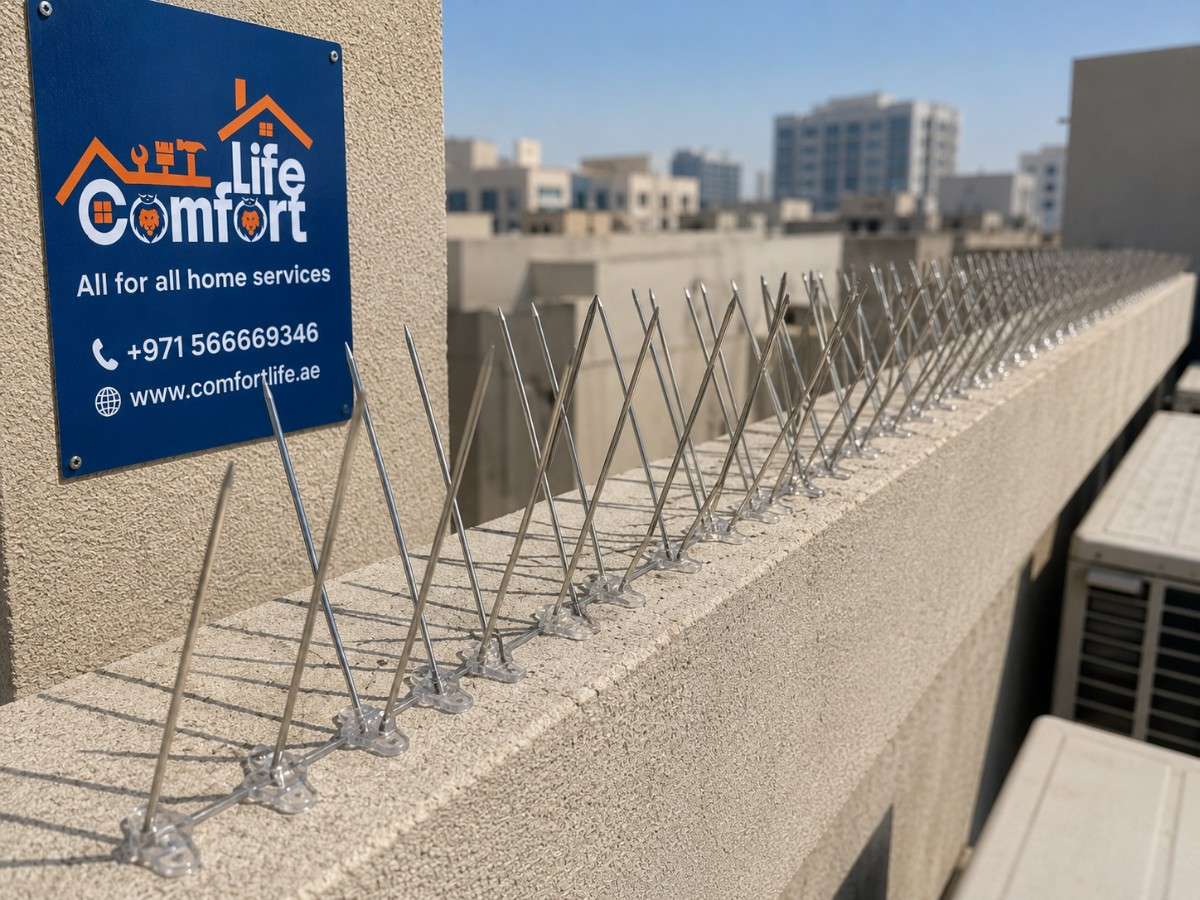
Looking for professional bird spikes installation service in Dubai? Comfort Life provides reliable bird control solutions to protect homes and commercial properties from pigeons and other nuisance birds. Our team installs high-quality bird spikes that help prevent birds from landing, nesting, and creating mess around your property.
Bird droppings and nesting can damage buildings, create hygiene issues, and affect the appearance of balconies, rooftops, AC units, and ledges. Our trained technicians ensure safe and effective installation with long-lasting protection. We also provide complete handyman services, cleaning services, and maintenance solutions.
We provide bird spikes installation for residential and commercial properties including:
Our installation process is safe, clean, and designed for long-term results.
We offer affordable bird spikes installation services in Dubai with transparent pricing.
You receive a clear quotation before installation begins.
We focus on preventing recurring bird problems with practical and effective solutions.
We provide bird spikes installation across Dubai including Dubai Marina, JLT, Business Bay, Downtown Dubai, Palm Jumeirah, JVC, Al Barsha, Arabian Ranches, Dubai Hills, Mirdif, Al Qusais, Silicon Oasis, and surrounding areas.
Pigeons are looking for three things: a flat surface to stand on, shelter from wind and direct sun, and a spot high enough to feel safe from anything on the ground. A Dubai balcony offers all three, and so does the top of a split AC outdoor unit, a window ledge, a parapet edge and the flat top of a shop sign.
Once a pair has roosted somewhere for a few weeks they treat it as home, and if they nest successfully the next generation returns to the same building. That is why the problem tends to get worse rather than settle, and why chasing the birds away or cleaning the balcony repeatedly does not solve it. Until the surface itself stops being comfortable to land on, they come back.
The damage builds up quietly. Droppings are acidic and will stain and eventually etch paint, aluminium and glass balustrades. Nesting material collects in AC units, gutters and balcony drains, and a blocked balcony drain in a rare heavy rain is how water finds its way into a living room. Feathers and debris drawn into an air conditioning unit reduce its airflow and add to your running costs.
Spikes work on any narrow surface a bird wants to perch or roost on. In Dubai homes the most common positions are balcony railings and the top rail of glass balustrades, window ledges and sills, parapet walls and roof edges, the top and sides of split AC outdoor units, the ledges above and below signage, pergola beams and shaded structures, and the tops of light fittings and CCTV housings.
Not every surface suits spikes. A wide flat area such as an open roof section or a large balcony floor cannot be covered economically with spikes and is better handled with netting. Our surveyor will tell you which parts of your property are a spike job and which are not, rather than fitting spikes everywhere and leaving you with birds still landing in the middle.
There are two materials in common use and both have a place. Stainless steel spikes are the stronger option and hold their shape for years in this climate. They are the right choice for exposed positions taking direct sun, for roof and parapet edges, for commercial buildings and for anywhere the installation needs to be forgotten about once it is done. Grade matters, because a low grade steel will show rust streaks down a wall within a season near the coast.
Polycarbonate spikes are clear or translucent and almost invisible against glass and light-coloured stonework, which makes them the discreet option for a villa facade or a balcony where appearance matters. Good polycarbonate is UV stabilised, but the material is still working harder in Dubai sun than it would elsewhere, so it suits sheltered and semi-shaded positions better than fully exposed roof edges.
Both types are supplied on a base strip that is either screwed or bonded to the surface, and we choose the fixing method based on what the surface is and whether you can accept drilling into it.
Spikes are the right answer for edges and narrow ledges, which covers the majority of residential problems. They are discreet, low maintenance and they last.
Netting is the answer when you need to close off a whole volume rather than a line, for example enclosing a balcony completely, protecting a plant room, or sealing an open area under a roof structure. It costs more and needs careful tensioning and fixing to look right, but nothing else keeps birds out of an open space as reliably.
Optical and gel deterrents have a narrower role. They can help on a small isolated ledge or as a supplement, but a gel is a consumable that degrades in high heat and needs replacing, and reflective deterrents lose effect once the birds get used to them. We will say plainly where one of these is a sensible low-cost fix and where it is money you will spend again in six months.
Spikes should never simply be fitted on top of an accumulation of droppings and nesting material. The debris has to come off first, both because the fixings need a clean surface to hold properly and because leaving the mess in place leaves the smell and the staining behind the new installation where nobody can reach it.
Our team scrapes and removes nesting material and droppings, cleans the surface and applies a disinfectant before the spikes go on. Waste is bagged and taken away rather than swept off a ledge onto whatever is below. Where droppings have already stained paintwork or stonework, we will tell you what is likely to clean up and what has etched permanently, so you know before the spikes go on whether you also want that surface repainted.
If there is an active nest with eggs or chicks, tell us at the survey. We will advise on timing rather than simply removing it.
This is the question we are asked most, and the answer is no when spikes are chosen and fitted correctly. Bird spikes are a deterrent, not a trap and not a weapon. The points are blunt enough not to injure and the spacing is designed so that a bird finds the surface unstable and simply chooses to land elsewhere. They are used on heritage buildings, hospitals and public infrastructure all over the world for exactly this reason.
What matters is correct installation. Spikes fitted too far apart let birds land between them, which is both ineffective and the only realistic way a bird gets caught up in an installation. Correct spacing and full coverage of the ledge is what keeps the system humane as well as effective, and it is one of the clearest differences between a professional installation and a cheap one.
Every property is different, so the job starts with a look at the actual surfaces. Our surveyor checks where the birds are actually landing rather than only where you have noticed the mess, because droppings collect below a perch and the perch itself is often a floor above. We measure the total running length of ledge to be covered, note the surface material at each position, identify anything that needs cleaning first, and check what access is required.
Running length is what determines the size of the job, since spikes are supplied and fitted per metre of edge. That is why an accurate measure matters and why a quotation given over the phone without seeing the property is usually wrong in one direction or the other.
You get a clear scope from the survey: which surfaces are being covered, what material is being used, how it is being fixed, and what cleaning is included.
In apartment buildings, work on a balcony or an external ledge usually needs the approval of building management, and some communities have rules about what may be fixed to a facade or how it may look from outside. We can provide the paperwork building management asks for from the contractor side, and where appearance is a concern, polycarbonate spikes on a light surface are close to invisible from street level.
Villa work is more straightforward, though roof edges and high parapets need proper access equipment rather than a ladder balanced on a wall. Our team works at height with the right equipment and does not take shortcuts on this, both for the obvious safety reason and because a rushed installation at height is exactly the one that comes loose later.
A correctly fitted stainless steel installation should last many years with no attention at all. The failure points are almost always fixing related rather than the spikes themselves: an adhesive that was not rated for these surface temperatures, or a base strip fitted to a dusty surface that never bonded properly. We use fixings appropriate to the surface and, where adhesive is the only option because you do not want drilling, we say so and we use a product suited to the heat.
It is worth a quick look at the installation once a year, particularly after a period of strong winds. Check that no section has lifted at the end of a run, and clear any debris or windblown material that has collected on the strip, since a build-up of leaves and dust across the spikes eventually creates the flat surface you were trying to remove. If a section does need attention, tell us and we will come back to it.
Customers often combine electrical work with other maintenance solutions:
All services can be booked easily through the Comfort Life platform.
Quick answers to common service questions in Dubai.


We work across the whole of Dubai. Choose your area to see what we do there and book a slot.


Choose Location