
Choose Location
5 (5 Reviews & Ratings)
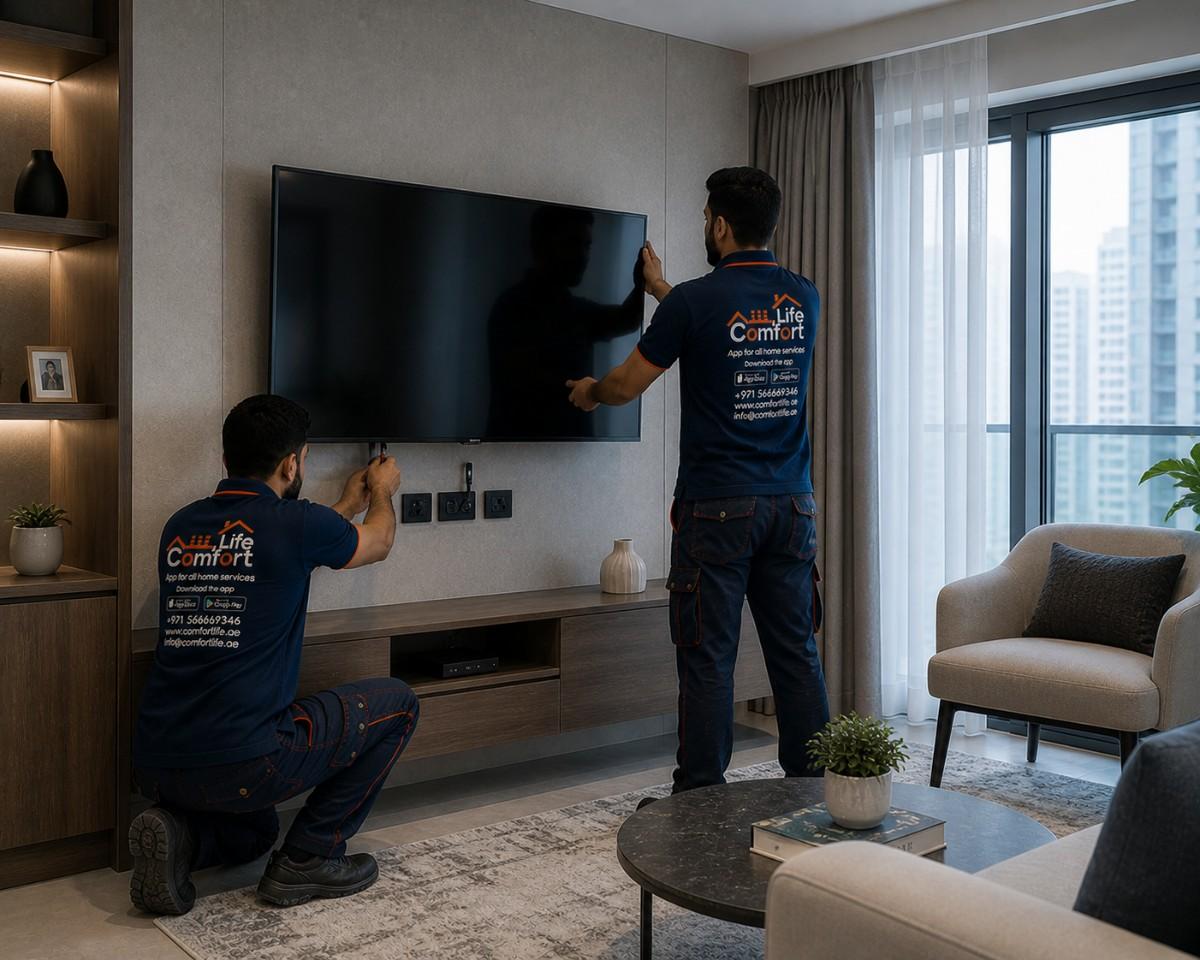
Enjoy a perfect viewing experience with professional TV installation services in Dubai by Comfort Life. We provide reliable TV wall mounting, bracket installation, cable setup, and TV fixing services for apartments, villas, offices, and commercial spaces. Whether you need a new TV installed, an old TV repositioned, or cables managed neatly, our technicians ensure safe, secure, and clean installation across Dubai.
TV wall mounting
TV bracket installation
LED TV installation
Smart TV installation
TV unmounting and reinstallation
Cable management and concealment
TV alignment and leveling
Wall drilling and secure mounting
Home theater TV setup
TV installation with sound system support
Our TV wall mounting services ensure your TV is securely installed with proper alignment and a clean finish. We use high-quality tools and ensure damage-free installation.
TV Installation (32–55 inch) – AED 125
TV Installation (55–75 inch) – AED 145
TV Installation (75+ inch) – AED 165
TV Unmounting & Reinstallation – AED 125
Professional TV installation solutions in Dubai
Experienced technicians for secure wall mounting
Suitable for homes, apartments, villas, and offices
Clean cable management and neat finishing
Affordable pricing with fast service
Trusted home maintenance company serving Dubai
We provide TV installation services across Dubai, including Dubai Marina, Jumeirah, Downtown Dubai, Business Bay, Al Barsha, Deira, Bur Dubai, Al Qusais, Mirdif, JVC, JLT, Arabian Ranches, Silicon Oasis, International City, and nearby areas.
The single biggest factor in a safe TV installation is what is behind the plaster. Dubai homes are built with a mix of solid concrete, hollow block and gypsum partition walls, and each one takes a completely different fixing. Getting this wrong is how televisions end up on the floor.
Solid concrete is the strongest and most common surface in villas and older towers. It takes a heavy-duty anchor and will hold any size of screen without difficulty, though it needs proper drilling equipment rather than a domestic drill. Hollow block needs a fixing designed to expand inside the cavity, because a standard plug simply spins in the void and pulls out under load.
Gypsum and drywall partitions are the ones to be careful with. These are very common in apartments, particularly for the feature wall in a living room, and the board itself carries almost no weight. A safe installation on drywall means locating the metal studs behind the board and fixing into them, or adding backing where the studs do not line up with where you want the screen. Our technician taps and tests the wall before drilling and will tell you straight away if the position you have chosen is not safe, along with the nearest position that is.
A fixed bracket holds the screen flat and close to the wall. It gives the cleanest look, costs the least and is the right choice when your seating is directly in front of the television at roughly eye level. It also leaves the least room behind the set, so cables need planning before the screen goes up.
A tilting bracket lets the screen angle downwards, which matters when the television has to go higher than ideal, for example above a fireplace or a tall media unit. Tilting the screen towards the seating removes the glare from ceiling lights and stops you looking up at the picture from below.
A full-motion or articulated bracket swings out and rotates. It is the answer for corner installations, for open-plan rooms where you want to watch from both the sofa and the dining table, and for kitchens. It costs more and needs a stronger fixing because the arm multiplies the leverage on the wall, so a full-motion mount on a partition wall almost always needs proper stud fixing rather than plasterboard anchors.
The most common regret after an installation is a television mounted too high. The centre of the screen should sit at roughly eye level when you are seated, which for most sofas puts the middle of the screen around one metre to 1.2 metres from the floor. On a large screen that can mean the bottom edge is lower than people expect, and it looks unusual on the wall while feeling completely natural once you sit down.
Above a fireplace or a console with a tall unit beneath it, the screen has to go higher, and that is exactly where a tilting bracket earns its cost. Before drilling, our technician holds the bracket at the proposed position and lets you sit down and look at it, so the height is agreed while it is still easy to change.
A well-mounted television with cables hanging down the wall looks unfinished. There are three ways to deal with it and we will talk you through which suits your home and your tenancy.
The simplest is a slim trunking channel run down the wall, which can be painted to match and hides power and HDMI cables neatly. It is fast, reversible and does not damage the wall beyond the fixings.
The tidiest is running cables inside the wall to a lower outlet, which leaves nothing visible at all. This is straightforward in a drywall partition and involves more work in solid block or concrete. It also needs the power side handled properly rather than dropping a standard cable inside a wall.
The third option is simply to route cables behind furniture where the media unit already sits below the screen. It costs nothing and works well when the gap between the screen and the unit is small.
Most installations involve more than the screen. Soundbars can be wall mounted directly below the television or sit on the unit beneath, and a wall-mounted bar usually looks better and keeps the shelf clear. We can mount the bar in line with the screen so the two look like a single unit rather than two separate pieces.
We also connect and test what you already own: receivers, streaming boxes, gaming consoles, satellite decoders and sound systems. Before leaving, the technician checks that every input switches correctly, that the picture is coming through at the right resolution, and that your remote controls the screen properly. If a device needs its own setup, such as connecting to your home network, the technician will get it working rather than leaving you with a box and a cable.
Renting does not stop you mounting a television, but it is worth thinking about the end of the tenancy at the start. Most landlords accept a wall mount provided the wall is made good when you leave, and the cost of filling and touching up a few anchor holes is small compared with the difference a properly mounted screen makes to a living room.
Check your tenancy contract and, in an apartment, whether building management restricts drilling hours. If you would rather avoid fixings in a feature wall entirely, tell us and we can look at alternative positions or a floor-standing solution.
We also handle the other end of this. If you are moving out or moving home, we can remove the television and bracket, make good the holes, and reinstall the screen at your new address on the same visit or a scheduled one.
Our technician arrives with the drilling equipment, a stud and cable detector, a spirit level, the fixings suited to your wall type and the tools to assemble the bracket. If you have already bought a bracket we will fit it, and if you have not, tell us your screen size and wall type when booking so the right one comes with the technician.
A straightforward installation on a suitable wall usually takes around an hour to ninety minutes including unboxing, assembly, mounting, connecting devices and testing. Add time for concealed cabling, a full-motion bracket, a very large screen that needs two people, or a wall that needs additional preparation. If anything on site changes the scope, you are told before the work continues rather than afterwards.
Before the technician leaves, the packaging is cleared away, the drilling dust is cleaned up and you get a demonstration that the screen is level, secure and working on every input.
Every bracket carries a maximum weight and a range of VESA mounting patterns, which is the spacing of the four threaded holes on the back of your television. A bracket that does not match the pattern cannot be fitted safely, and one that is rated below the weight of the screen should never be used even if it appears to hold.
Modern televisions are lighter than they look, and a large screen is often well within the range of a standard mount on a solid wall. The limiting factor is almost always the wall rather than the bracket. Where the wall cannot safely take the screen you want in the position you want, we say so and offer a workable alternative instead of proceeding and hoping. A television coming off a wall is a serious accident, particularly in a home with children, and it is not a risk worth taking to save an hour of work.
Customers often combine electrical work with other maintenance solutions:
All services can be booked easily through the Comfort Life platform.
Quick answers to common service questions in Dubai.


We work across the whole of Dubai. Choose your area to see what we do there and book a slot.

Ali Alhaj Al Ali 5.0
10 Oct 2026 05:28PMexcellent service
Salvatore Circo 5.0
12 Sep 2026 09:54AMReally happy with the TV relocation and installation. Very professional and good customer service.
Definitecom 5.0
05 Jun 2026 11:16AMbest service