
Choose Location
5 (2 Reviews & Ratings)
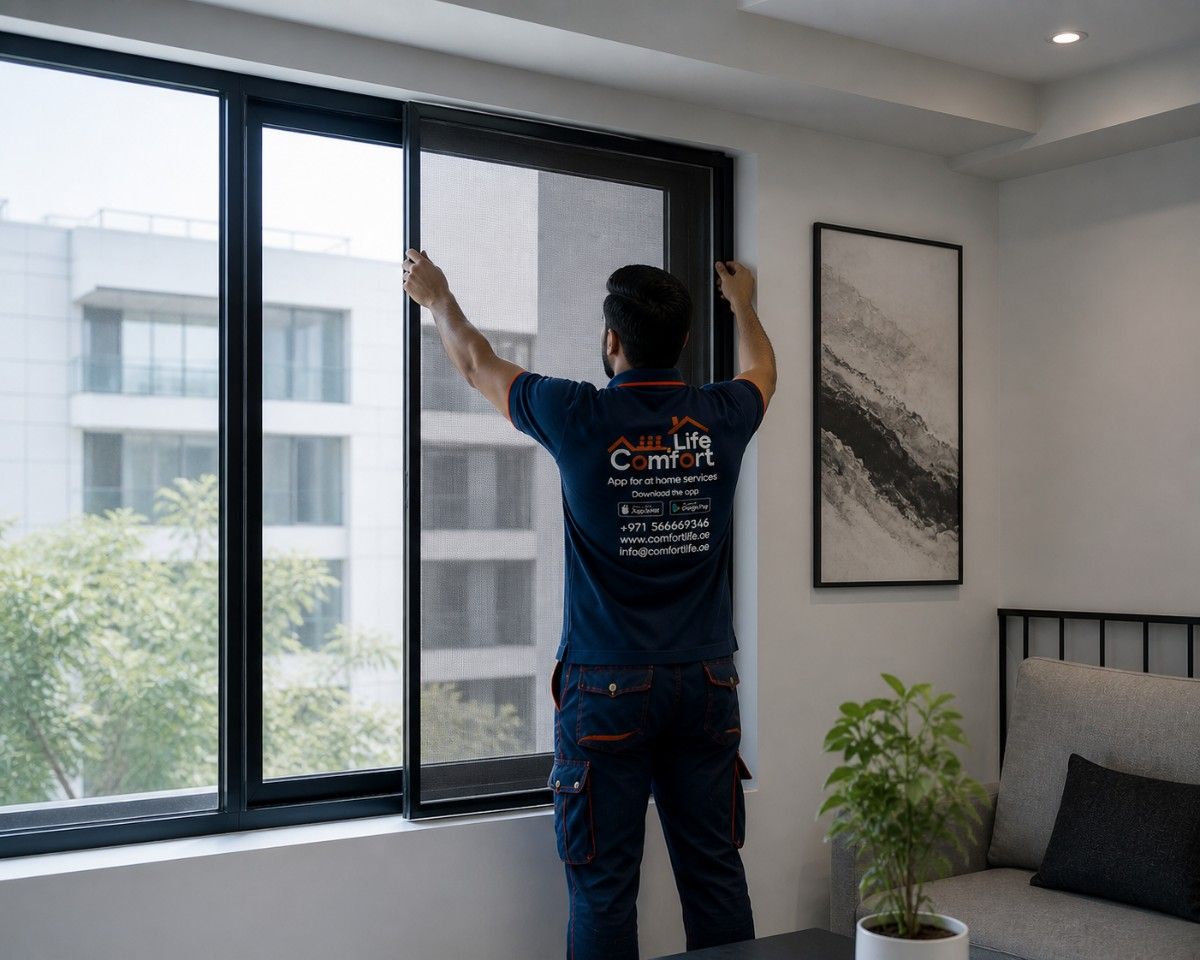
Keep your home fresh, clean, and insect-free with professional fly screen installation services in Dubai by Comfort Life. We provide reliable window mesh installation, door fly screen fixing, and custom mosquito net solutions for apartments, villas, offices, and commercial spaces. Whether you need new fly screens installed or old ones replaced, our technicians ensure secure fitting and a clean finish across Dubai.
Fly screens are priced by the area of the opening, not by the type of screen. Measure the width and the height of the window or door, multiply them, and that gives you the square footage. One price covers the frame, the mesh and the fitting.
| Coverage | Price | Typical use |
|---|---|---|
| Up to 10 sq ft | AED 125 | A standard bedroom or kitchen window |
| Up to 20 sq ft | AED 165 | A large window or a single door |
| Up to 40 sq ft | AED 250 | A sliding door or a balcony opening |
| Larger or non-standard | Quoted on site | Custom shapes, very large openings, unusual frames |
Send a photo with the measurements and we will confirm the price before the technician comes out. There is no call-out fee and no advance payment.
Our window fly screen installation services help protect your indoor space from insects while maintaining airflow and visibility. We use high-quality mesh and durable frames for long-lasting performance.
We provide strong and secure fly screen installation for doors, including sliding and hinged options suitable for homes and offices.
If you need repair, adjustment, or quick fixing, you can book a technician on an hourly basis.
We provide fly screen installation services across Dubai, including Dubai Marina, Jumeirah, Downtown Dubai, Business Bay, Al Barsha, Deira, Bur Dubai, Al Qusais, Mirdif, JVC, JLT, Arabian Ranches, Silicon Oasis, International City, and nearby areas.
For much of the year the weather here makes it worth opening the windows, and the cooler months are exactly when people want a balcony door open through the evening. The problem is what comes in with the air. Mosquitoes appear in numbers after rain and around standing water, flies find their way in from bin areas and communal spaces, and moths and small insects are drawn to interior lighting after dark.
A fly screen means you can open up the house without that trade-off. It also keeps out windblown dust and leaves, which is a real benefit on the balcony side of an apartment, and on a high floor it gives a barrier at an open window that many families with young children and cats want in place regardless of insects.
Running the air conditioning less during the pleasant months is the other quiet benefit. If the windows can stay open at night without insects coming in, that is several months of the year where natural ventilation replaces the AC for part of the day.
The right type depends on the opening and on how often you want to use it. A fixed frame screen sits permanently in the window opening. It is the simplest, the most economical and the most robust, and it suits any window that you are happy to have screened all the time.
Sliding screens run on a track alongside a sliding window or door and slide across when you want them and back when you do not. They are the natural match for a sliding balcony door where a fixed screen would block the opening.
Pleated screens fold concertina-fashion to one side and almost disappear when open. They handle wide openings well and are popular for large balcony doors and for anyone who does not want a permanent screen in the sightline.
Roller screens retract into a cassette at the top or side, much like a blind, and are hidden completely when not in use. They are the most discreet option and the best choice where appearance matters, though the cassette and side channels take more space around the opening than a fixed frame.
Hinged or magnetic door screens suit a single door that is used constantly, for example a kitchen door onto a yard, because they close behind you without needing a hand.
The mesh matters as much as the frame. Standard fibreglass mesh is the default and does its job well: it is inexpensive, has good visibility, and flexes rather than creasing if something pushes against it.
Aluminium mesh is stiffer and more durable and holds its shape better on large panels, though it dents rather than springing back. Where a screen is at ground level, on a door in constant use or anywhere it will be knocked, the extra rigidity is worth having.
Pet-resistant mesh is a heavy-duty vinyl-coated polyester designed to survive a cat or dog pushing at it. If you have pets, this is the difference between a screen that lasts and one that needs re-meshing every few months.
Fine or micro mesh has a tighter weave that stops the very small insects a standard mesh lets through. It reduces airflow slightly, which is the trade-off to be aware of, but on a bedroom window that faces a garden or water feature it is usually worth it. There are also solar and privacy meshes that cut glare and reduce the view in from outside during daylight.
Screens are made to the opening, so the measuring visit is the part that decides whether the finished screen looks like it belongs. We measure each opening individually rather than assuming windows of the same nominal size are identical, because they rarely are, and we check whether the screen should sit inside the reveal or fit to the face of the frame.
Frames come in a range of standard finishes, and matching the screen frame to your existing window frame makes the screen almost disappear from inside the room. White, brown, black and natural aluminium cover most Dubai window frames. Tell us at the survey if appearance is a priority and we will look at both the frame colour and the mesh shade, since a darker mesh is actually less visible from inside than a light one.
Where windows are an unusual shape, arched, or have a handle or lock that a flush screen would block, that needs to be identified at measuring rather than discovered at installation.
Sliding balcony doors are the most common request and the one where the choice of type matters most, since a screen that makes the door awkward to use simply gets left open. A sliding or pleated screen on its own track keeps the door working normally.
Kitchen windows have their own consideration: cooking grease will collect on a mesh directly above or beside a hob, so an easily removable frame that can be taken out and washed is a better choice there than a fixed panel.
Bathroom and utility windows are usually small, high and rarely opened, which makes a simple fixed screen the sensible answer. Windows that open outwards, top-hung windows and anything with a projecting opener need the screen positioned so the window can still operate through its full travel, and that is worked out at the survey rather than on site on the day.
Every screen reduces airflow to some degree, because the mesh is physically in the way. A standard mesh takes a modest amount off, a fine mesh takes more, and a dirty mesh takes far more than either, which is the main practical argument for cleaning them.
In a room where you rely on cross ventilation, it is worth being deliberate about this: a standard mesh on the main airflow windows and a finer mesh only where small insects are a specific problem gives a better result than the finest mesh everywhere. We will talk this through at the survey rather than fitting the same specification to every opening.
A damaged screen very often does not need replacing. If the frame is straight and the corners are sound, the mesh alone can be replaced at a fraction of the cost of a new screen, and that is what we will recommend where it is the honest answer.
Common repairs include re-meshing a panel that has been pushed through or torn, replacing the rubber spline that holds the mesh in the frame when it has hardened and shrunk in the heat, fitting new rollers or wheels to a sliding screen that has become stiff, replacing a broken handle or latch, and straightening or re-squaring a frame that has been knocked. Where the frame itself is bent or the corner joints have failed, replacement is the better value and we will say so.
Screens collect the same dust everything else does here, and a clogged mesh both looks grey and cuts the airflow you fitted it for. A vacuum with a soft brush attachment every few weeks handles routine dust. Two or three times a year, take removable panels out and wash them with mild soapy water and a soft brush, rinse and let them dry fully before refitting.
Avoid pressure washers and stiff brushes, which stretch the mesh out of shape and loosen it from the spline. On sliding screens, keep the bottom track clear, since a track full of sand is what wears the rollers out and makes the screen stiff. If a screen has become hard to slide, clean the track before assuming the rollers have failed.
In apartment buildings some communities have rules about anything fitted to a window or balcony that changes how the facade looks from outside. Most fly screens are unobtrusive enough not to be an issue, and a dark mesh in a frame matched to the window is barely visible from street level, but it is worth checking your building rules before ordering if you are in a community with a strict facade policy. We can provide whatever paperwork building management asks for from the contractor side.
Installation itself is quick and clean. Most screens are fitted with minimal drilling and some types need none at all, which matters for tenants who want the option to remove everything at the end of a tenancy. If avoiding fixings altogether is important to you, say so at the survey and we will tell you which types will work in your openings.
Customers often combine electrical work with other maintenance solutions:
All services can be booked easily through the Comfort Life platform.
Quick answers to common service questions in Dubai.


We work across the whole of Dubai. Choose your area to see what we do there and book a slot.

Samir Abdo 5.0
25 Jul 2026 03:12PMvery professional and punctual team